Multi-Agent RAG: Moving Beyond Simple Retrieval
PUBLISHED: 6/11/2026
WRITTEN BY: Muhammad Muaz Arshad
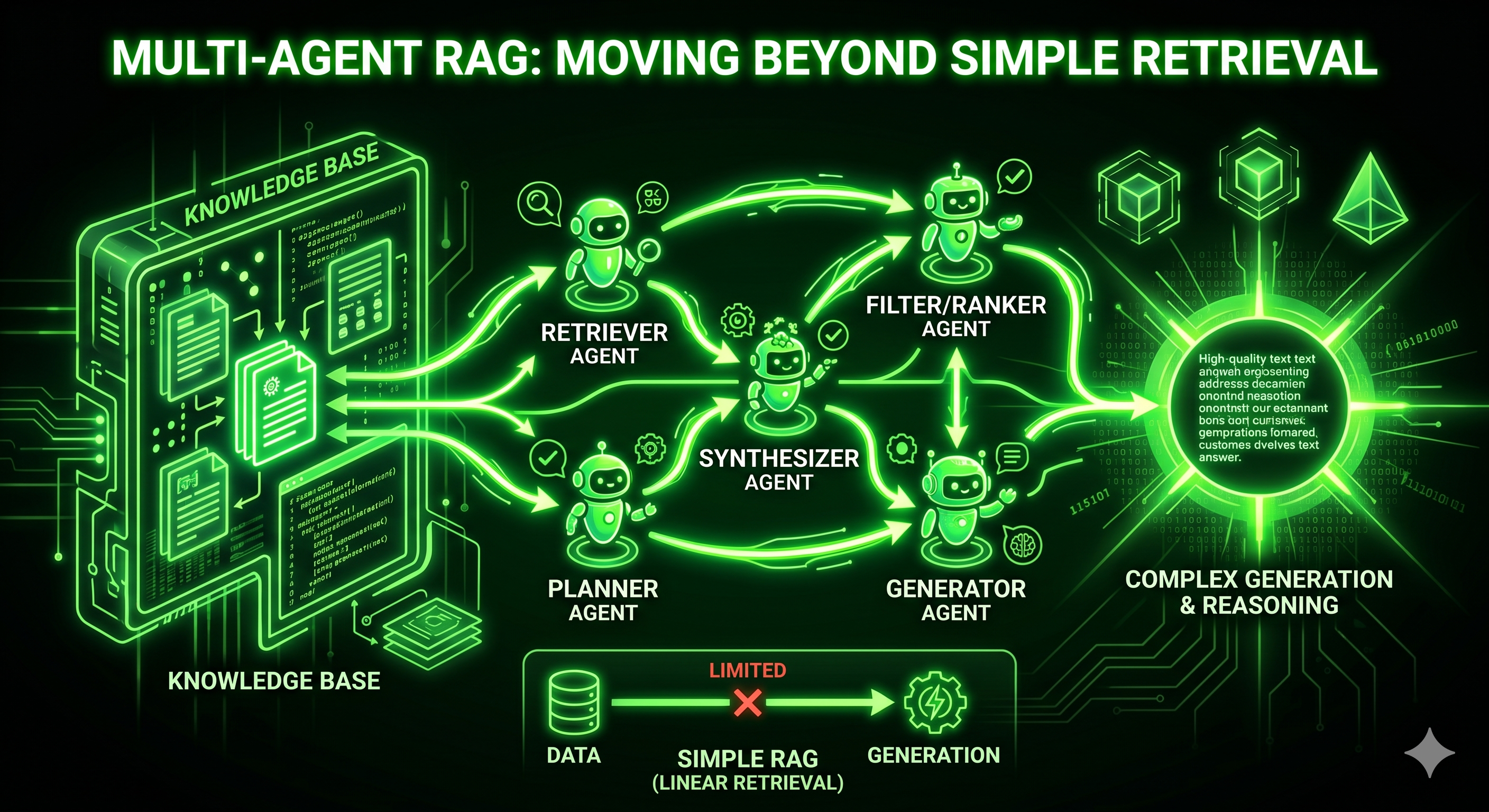
If you’ve built a generative AI application in the last year, you’ve likely built a Retrieval-Augmented Generation (RAG) pipeline. The premise is elegant and effective: vectorize your documents, store them in a database, perform a similarity search against a user's query, and feed the results to an LLM to generate an answer.
But standard RAG is quickly becoming commoditized. While it works beautifully for simple "needle in a haystack" queries, it breaks down when faced with complex, multi-step reasoning, conflicting data, or queries that require synthesizing information across vastly different domains.
To build enterprise-grade applications that don't just fetch data but actually solve problems, the industry is shifting toward Multi-Agent RAG.
The Bottleneck of Single-Pass Retrieval
In a traditional RAG setup, the pipeline is entirely linear. A query comes in, the system retrieves the top K chunks of text based on vector similarity, and the LLM synthesizes those exact chunks.
This creates three major bottlenecks:
- The "Lost in the Middle" Problem: If the retrieval step pulls in too much context, the LLM often ignores data buried in the middle of the prompt.
- Brittle Routing: A simple similarity search doesn't know if a query requires a deep dive into an SQL database, a quick scan of a PDF, or an API call to a live web server.
- Zero Course Correction: If the initial retrieval fetches the wrong chunks, the LLM will confidently hallucinate an answer based on bad data. It has no mechanism to say, "Wait, this doesn't make sense—let me search again using different keywords."
Enter Multi-Agent RAG
Multi-Agent RAG transforms this rigid pipeline into a dynamic, iterative team of specialized AI workers. Instead of a single LLM trying to do everything at once, the workload is distributed across specialized "agents" discrete instances of an LLM prompted with a specific persona, set of instructions, and access to specific tools.
In a well-architected multi-agent system, the workflow isn't a straight line; it's a loop of reflection, planning, and tool execution.
The Core Agents in a RAG Ecosystem
When you break down the retrieval process into an agentic workflow, you typically deploy a "team" that looks something like this:
1. The Router Agent (The Traffic Cop)
The Router is the first point of contact. Its sole job is intent classification. When a user asks, "How did our Q3 revenue compare to Q2, and what did the CEO say about it in the all-hands?" the Router recognizes that this requires two distinct data sources. It dispatches a sub-query to the SQL Agent for the financial data, and another to the Vector Agent for the unstructured transcript data.
2. The Retriever Agents (The Specialists)
Instead of one massive, noisy vector database, a multi-agent system often uses specialized retrievers:
- The Vector Agent: Specialized in semantic search across unstructured text (PDFs, docs).
- The Graph Agent: Specialized in querying Knowledge Graphs to find relationships between entities (e.g., "Who manages the team that shipped feature X?").
- The SQL/Tabular Agent: Writes and executes queries against structured databases.
3. The Critic / Verifier Agent (The Editor)
This is where multi-agent RAG truly outshines standard pipelines. Once a Retriever fetches data, the Verifier Agent evaluates it against the original prompt. It asks: Does this context actually answer the user's question?
- If yes, it passes the data forward.
- If no, it actively rewrites the search query and sends the Retriever back to the database. This self-correcting loop drastically reduces hallucinations.
4. The Synthesizer Agent (The Presenter)
Finally, once all the verified, highly-relevant data is gathered from the various specialists, the Synthesizer weaves it together into a coherent, properly cited response tailored to the user's requested format.
Building the Stack
Implementing this requires moving away from basic wrapper libraries and adopting orchestration frameworks designed for stateful, multi-actor routing.
- Orchestration: LangGraph and CrewAI are currently the leading frameworks. LangGraph is exceptional for treating agent workflows as state machines (graphs), allowing you to build reliable, cyclical loops (like the Retriever-Verifier loop).
- Storage (The Memory): You still need excellent retrieval. Vector databases like Qdrant, Pinecone, or pgvector handle the unstructured data, while graph databases like Neo4j are increasingly paired with them to map complex entity relationships (GraphRAG).
- Models: You don't need massive models for every agent. A common pattern is using a highly capable model like GPT-4o or Claude 3.5 Sonnet for the Router and Synthesizer, while using faster, cheaper, or locally hosted models (like Llama 3 8B) for the repetitive Retriever and Critic tasks.
The Future is Collaborative
Standard RAG taught AI how to read our documents. Multi-Agent RAG is teaching AI how to research them.
By breaking complex queries into discrete, manageable tasks and allowing models to check their own work, we move from systems that simply parrot retrieved text to resilient, autonomous researchers capable of tackling enterprise-scale complexity.