The AI Ecosystem in Healthcare: From Cloud to Clinic
PUBLISHED: 6/11/2026
WRITTEN BY: Affan Khan
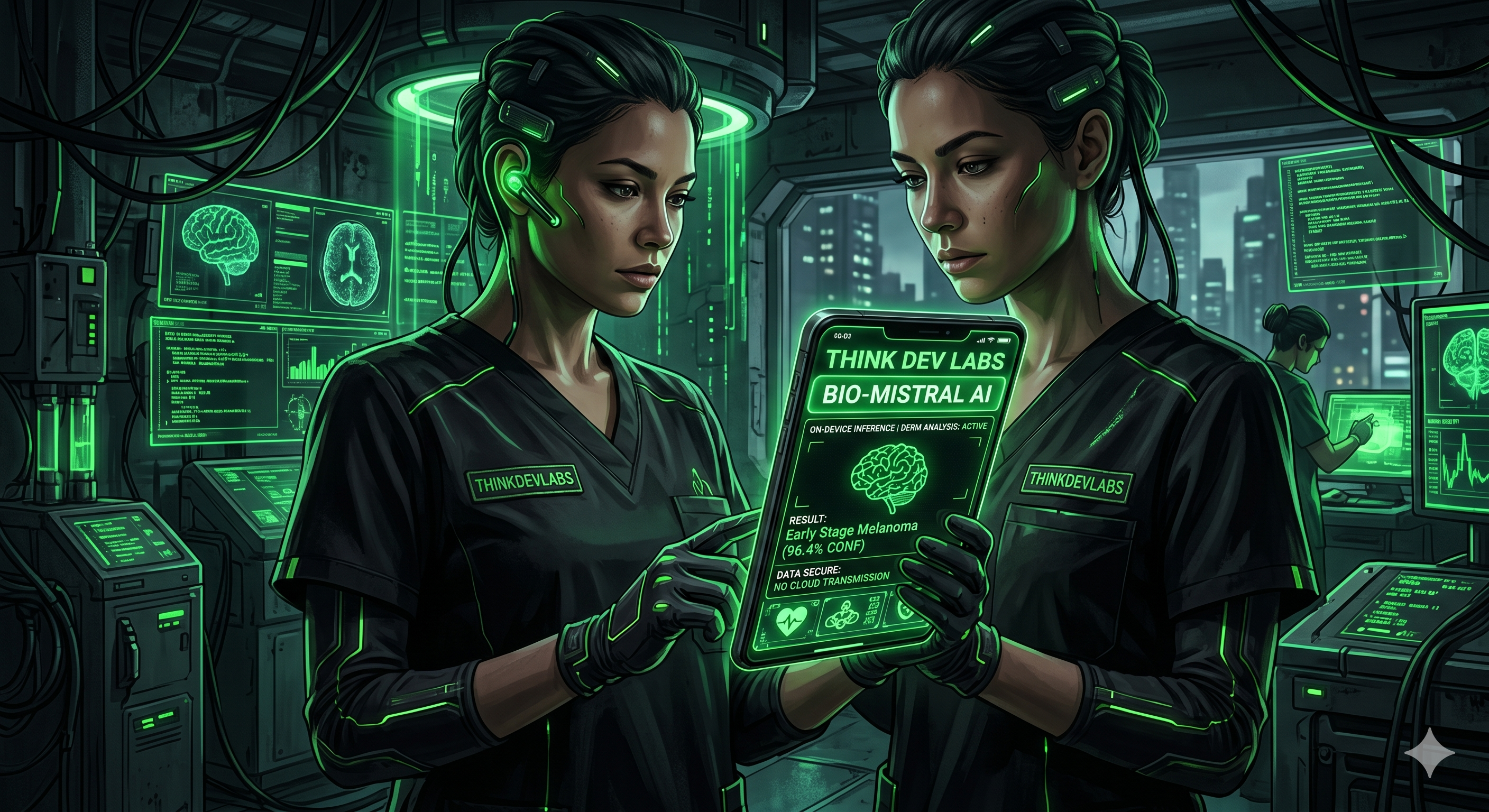
Artificial Intelligence in healthcare is no longer just a buzzword about "the hospital of the future" it is the invisible infrastructure powering everything from back-office administration to life-saving diagnostics today. As the global AI healthcare market aggressively expands, the technology is fundamentally altering how we process medical data, discover drugs, and interact with patients.
Here is a deep dive into how AI is shifting the medical landscape, and how ThinkDevLabs is engineering the next generation of these tools by prioritizing privacy and edge computing.
1. The Macro Impact: How AI is Rewiring Medicine
The true value of AI in healthcare isn't replacing doctors; it's augmenting their capabilities and removing operational friction. The transformation is happening across four distinct pillars:
Diagnostic Precision and Imaging
In fields like radiology and pathology, AI acts as an tireless second set of eyes. Modern computer vision models are trained on millions of annotated scans, allowing them to detect microscopic anomalies like early-stage lung nodules or diabetic retinopathy that human fatigue might miss.
- The impact: AI-assisted screening reduces false-negative rates and significantly speeds up triage, ensuring that critical cases are bumped to the top of a radiologist's queue instantly.
Predictive Analytics and Operations
Hospitals generate massive amounts of unstructured data. Predictive models analyze patient histories, vital signs, and even staffing schedules to forecast clinical events.
- Sepsis prediction: AI algorithms can monitor EHRs in real-time to detect the subtle, early warning signs of sepsis hours before clinical symptoms appear.
- Resource allocation: Predictive systems help hospital administrators forecast bed demand during flu season or manage operating room turnover, directly reducing overhead costs.
Accelerated Drug Discovery
Historically, bringing a new drug to market takes over a decade and billions of dollars. AI is compressing this timeline. By using deep learning to predict how proteins fold and how different molecular compounds will interact, researchers can computationally screen millions of potential drug candidates in days, isolating the most viable options for physical trials.
Ambient Clinical Intelligence
Physician burnout is a systemic crisis, largely driven by the administrative burden of charting. Ambient AI systems now listen to doctor-patient conversations (with consent) and automatically synthesize the dialogue into structured, clinically accurate EHR notes. This shifts the physician's focus back to the patient.
2. ThinkDevLabs: Building the Next Generation of Care
While massive health networks rely on heavy, centralized cloud infrastructure, ThinkDevLabs is approaching healthcare AI from a different angle. The agency focuses on building localized, privacy-first solutions that put clinical-grade intelligence directly into the hands of users.
Bypassing the Cloud with Edge Computing
Most healthcare apps send sensitive user data (like images or symptoms) to a remote server for processing. This introduces latency, requires a constant internet connection, and, most importantly, creates a massive privacy vulnerability.
ThinkDevLabs solves this through On-Device Inference. By compiling highly optimized machine learning models (often deployed as compressed .pth files) directly into mobile applications, the AI runs entirely on the user's phone.
- The result: The patient's data—whether it's a photo of a skin lesion or a log of sensitive symptoms—never leaves their physical device. Privacy isn't just a policy; it's structurally guaranteed by the architecture.
Medical-Grade Intelligence with BioMistral
General-purpose LLMs (like standard ChatGPT) are incredible tools, but they are trained on the open internet which includes a lot of medical misinformation. For specialized healthcare applications, such as a dermatological analysis app, ThinkDevLabs utilizes BioMistral.
BioMistral is an open-source Large Language Model that has been rigorously fine-tuned specifically on PubMed Central and peer-reviewed medical literature. When a user queries the application, they aren't getting generalized web advice; they are receiving insights generated by an engine that natively "speaks" clinical medicine.
Advanced RAG for Hallucination Prevention
Even highly trained models can occasionally "hallucinate" or invent facts. To prevent this in a healthcare context, ThinkDevLabs employs a robust Retrieval-Augmented Generation (RAG) pipeline.
- When a user asks a question, the system first queries a vector database filled with verified, up-to-date medical guidelines.
- It retrieves the exact factual context needed to answer the question.
- It forces the LLM to base its response only on that retrieved medical data.
This architecture ensures high-fidelity, reliable advice while relying on secure, scalable backends (like AWS RDS) to manage encrypted user profiles and application state.
By fusing modern mobile development with edge-deployed, clinical AI, ThinkDevLabs is proving that the most secure and accessible healthcare tools of tomorrow are the ones that live directly in our pockets.