The Rise of Agentic AI: How AI Agents are Redefining the Software Development Life Cycle
PUBLISHED: 6/13/2026
WRITTEN BY: Muhammad Muaz Arshad
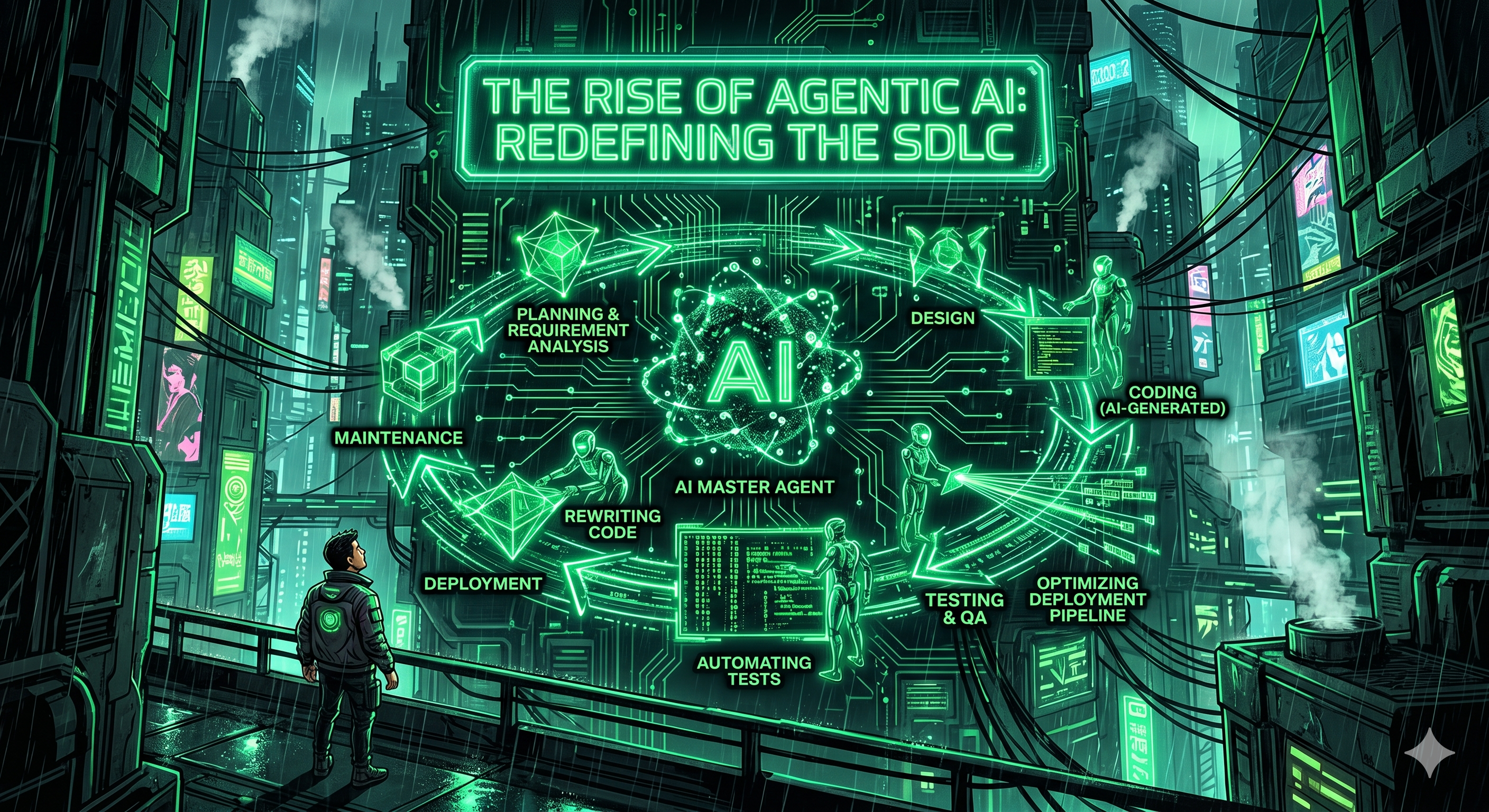
The software engineering landscape is undergoing its most profound paradigm shift since the transition from assembly language to high-level programming. For the past several years, artificial intelligence in software development was primarily assistive operating as an advanced autocomplete mechanism that accelerated syntax writing, generated boilerplate code, and answered localized technical questions.
Today, we are firmly entrenched in the era of Agentic AI.
Unlike passive chatbots or inline completion tools, AI agents possess autonomy, reasoning, and the ability to use tools. They do not just write code when prompted; they plan, execute, test, debug, and deploy software systems with minimal human intervention. This shift from "co-pilots" to "autonomous agents" is fundamentally re-architecting the Software Development Life Cycle (SDLC).
1. Defining Agentic AI in Software Engineering
To understand its impact on the SDLC, we must first define what makes an AI system "agentic." While standard generative AI models respond to isolated prompts, an AI agent operates within a continuous loop of perception, planning, tool usage, and action.
An engineering-focused AI agent relies on a specialized architecture:
- The Core LLM/Reasoning Engine: Brains that analyze complex instructions and break them down into multi-step goals.
- Memory Systems: Short-term memory (managing the current execution context and error logs) and long-term memory (understanding the repository’s overarching architecture and historical commits).
- Tool Integrations: The ability to interact with the digital environment. This includes reading and writing files, executing terminal commands, spinning up local containers, calling APIs, and running test suites.
- Self-Correction Loops: The capability to evaluate its own output. If an agent runs a command and encounters a stack trace or a failing test, it reads the error, refactors its code, and runs the test again until it passes.
2. Re-Architecting the Phases of the SDLC
The traditional SDLC is a structured, often bureaucratic sequence of phases. Agentic AI compresses these phases, introduces continuous parallel processing, and removes classic bottlenecks.
Phase 1: Requirements Gathering and Product Planning
Historically, product managers wrote lengthy Product Requirement Documents (PRDs), which engineers then spent weeks translating into technical specifications.
Agentic AI transforms this by acting as a bridge between natural business language and technical architecture. Multi-agent systems can now ingest a raw PRD, cross-reference it with existing system documentation, and autonomously generate granular user stories, database schema definitions, API contracts, and security compliance checklists. By simulating user behaviors and edge cases during the planning phase, agents can identify logical contradictions in product requirements before a single line of code is written.
Phase 2: Architecture and System Design
System design requires balancing scalability, cost, maintainability, and security. Agentic platforms can ingest a company's entire repository footprint to understand structural conventions.
When tasked with adding a complex feature such as a real-time notification engine an agent does not just write the feature code. It evaluates the existing ecosystem, drafts an architectural Request for Comments (RFC), proposes modifications to the microservices mesh, and suggests the optimal data storage strategy based on historical application loads.
Phase 3: Code Generation and Implementation
This is where the transition from assistive to agentic is most visible. Where an engineering tool used to wait for a developer to type a function, an agentic system is assigned an entire GitHub issue.
An agent tasked with an issue will clone the repository, create a feature branch, locate all relevant files across the frontend and backend, implement the feature while adhering to local linting paradigms, and write comprehensive unit and integration tests for the new code.
Phase 4: Testing and Quality Assurance
QA has traditionally been a game of catch-up, with engineers writing test automation scripts long after features are built. Agentic AI shifts testing entirely "to the left."
Agents do not just run existing test suites; they dynamically generate them based on code changes. If a code path changes, an agent detects the delta, creates negative test cases, performs boundary-value analysis, and conducts automated regression testing. Furthermore, specialized autonomous security agents can actively execute penetration tests against the newly compiled code to flag vulnerabilities like SQL injections before code review.
Phase 5: CI/CD, Deployment, and Operations
During a deployment pipeline, if an agentic CI/CD workflow detects a failure during the build or integration phase, it doesn't just halt the pipeline and alert an engineer. It analyzes the compiler logs, identifies the missing dependency or breaking change, commits a fix directly to the branch, and re-triggers the build. In production environments, modern observability agents monitor telemetry, predict anomalies, and can autonomously orchestrate safe, automated rollbacks when unexpected traffic spikes occur.
3. The Shift in the Developer’s Role: From Coder to Orchestrator
The rise of agentic AI does not signal the end of the human software engineer. Instead, it elevates the engineer’s role from a tactical writer of syntax to a strategic orchestrator of systems. This transformation alters several core aspects of the engineering profession:
- Primary Activity: Traditional engineers focus heavily on writing syntax, debugging runtime errors, and managing boilerplate. In the agentic era, engineers shift their focus to defining system boundaries, reviewing agent architectures, and prompting high-level intent.
- Speed to Delivery: Previously, delivery was bound by manual typing speed, context switching, and syntax debugging. Now, it is bound by the engineer's reasoning speed, review velocity, and architectural verification.
- Scope of Ownership: Where developers once managed isolated components or individual files, they now oversee end-to-end features, complex system integrations, and the mapping of overarching business logic.
- Focus Area: The old focus was on how to implement code correctly without breaking syntax or local rules. The modern focus is on why a specific architecture solves the business problem safely and scalably.
In this new paradigm, code review becomes the ultimate engineering skill. Developers spend less time figuring out how to write a loop and more time validating that the autonomous agent’s architectural choices align with long-term business goals, security policies, and performance constraints.
4. Current Bottlenecks and the Human-in-the-Loop Imperative
While agentic AI provides unprecedented velocity, it is not without significant risks and technical hurdles that mandate strict human oversight.
- Context Window Drift and Hallucination: Even with advanced memory frameworks, AI agents can lose track of global application context when working inside massive legacy codebases. A small hallucination in a deeply nested dependency can create silent bugs that bypass standard unit tests.
- Infinite Loop Financial Risks: Because agents operate autonomously in execution environments, a poorly constrained agent can fall into a recursive debugging loop repeatedly spinning up resources or calling expensive APIs resulting in sudden, unexpected operational costs.
- Security and Code Provenance: Agents frequently pull patterns from open-source training data or external documentation. Without strict scanning, an agent might inadvertently introduce code containing restrictive licenses or outdated, insecure packages.
To mitigate these risks, modern software houses are implementing a "Human-in-the-Loop" (HITL) framework. Agents operate within sandboxed container environments where high-risk actions such as merging to the main branch or altering production infrastructure require explicit cryptographic approval from a human engineer.
5. Conclusion: The Competitive Edge for Software Houses
Agentic AI is fundamentally reshaping software development from a labor-intensive craft into a highly scalable, automated engineering discipline. For software development houses, agencies, and enterprise IT departments, adoption is no longer optional for maintaining market relevance.
Organizations that successfully integrate agentic workflows into their SDLC can expect massive reductions in time-to-market, dramatic drops in regression bugs, and a workforce liberated from the mundane, repetitive elements of coding. By leveraging AI agents to manage the heavy lifting of implementation, testing, and deployment, human engineers are finally free to focus on what they do best: innovation, creative problem-solving, and building software that delivers genuine business value.